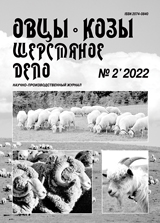
The magazine "Sheep, goats, wool business" was registered with the Russian Press Committee on 10.08.1995 No. 014000. It is the only industry scientific and production publication in the Russian Federation and CIS countries.
Since January 1, 2007, by the Resolution of the Higher Attestation Commission, the journal has been included in the list of peer-reviewed, leading scientific publications publishing materials for the degree of doctor and Candidate of Sciences in zootechnical and veterinary specialties.
The magazine covers a wide range of issues: breeding; breeding; genetics; reproduction; feeding; maintenance; production technology; quality of wool, meat, milk; prevention and treatment of diseases of sheep and goats. Authors of articles: researchers, university professors, applicants, graduate students, farm specialists, production workers.
Current issue
BREEDING, SELECTION, GENETICS
Sheep farming plays a vital role in ensuring the country’s food security, especially in regions with traditional pasture management, such as the Republic of Kalmykia. Given the growing demand for meat products, increasing the biological value of lamb through industrial crossbreeding is particularly important. This article examines the amino acid composition of the meat of crossbreeds produced by crossing Kalmyk fat-tailed sheep and Dorper × Kalmyk crossbreeds with Charolais rams. The experiment was conducted at the experimental farm of the Kalmyk Research Institute of Agriculture (2021-2024). The results showed that three-breed crossbreeds (½Sh × ¼Dp × ¼KKr) outperform their two-breed peers in the total content of essential and nonessential amino acids in meat by 19.6% (p < 0.0001) and 22.2% (p < 0.0001), respectively. The high tryptophan content in three-breed crossbreeds (193.29 mg/100 g) indicates an increase in the quality of meat protein.
Feeding rations and nutrient digestibility in purebred and crossbred lambs of the southern meat breed are shown, as well as the dynamics of body weight from 3 to 8 months of age and the results of the animals’ control slaughter. The digestibility of feed nutrients was highest in the crossbred lambs of group 4, with 7/8 blood of the Katum breed. The difference in the digestibility of organic matter and crude protein between animals of groups 1 and 4 was 5.49 and 5.67 absolute percent, respectively. For dry matter and crude fiber, the difference was 5.47 and 4.96 absolute percent, and it is highly significant. A significant increase in daily gains was observed in crossbred lambs of different bloodlines from katumskaya rams (from 223 to 245- 267 g) and a reduction in feed costs per 1 kg of body weight gain. The results of the control slaughter showed that the difference in pre-slaughter weight between purebred and crossbred animals was 5.7; 8.4; 11.5 kg or 10.4; 15.3; and 20.9%. For the weight of the carcass, the difference between the groups of rams was 3.72; 5.52; and 7.97 kg or 13.2; 19.5; and 28.2%, with a significant and highly significant difference.
SHEEP AND GOAT PRODUCTS
Sheep farming plays a major role in increasing meat production. Sheep have a complex set of economic and biological characteristics that dictate their breeding in various natural and climatic zones. Selecting the right breed is essential for the effective development of sheep farming.
The experimental portion of the study was conducted at the “Glava Lunin A.M.” peasant farm in the Orenburg Region. The article presents the results of age-specific determinations of tryptophan and hydroxyproline content, as well as protein quality indicators, in the muscle tissue of Romanov rams (Group I), wethers (Group II), and ewes (Group III). It was found that, due to sexual dimorphism, the muscle tissue of the rams was characterized by higher tryptophan content and protein quality indicators. No intergroup differences were observed in hydroxyproline content. When slaughtering young Romanov sheep, meat products were obtained that were distinguished by a fairly high biological value; ram lambs had a higher concentration of tryptophan in meat and the value of its BCP, ewes had the lowest, and wether lambs occupied an intermediate position.
The milk yield over 180 days of lactation and the main components of milk (fat, protein) were compared, and the yield of milk fat and milk protein for the study period was calculated. It was found that Alpine goats were characterized by higher milk yield compared to Alpo-Nubian crossbreeds (663.36 and 543.21 kg, respectively), while Alpo-Nubian crossbreeds had a higher fat (3.97%) and protein (3.47%) content in comparison with Alpine goats (2.98% and 2.76%, respectively). In terms of milk fat and protein yield, the Alpo-Nubian crossbreeds retained their advantage (21.59 and 18.84 kg) compared to the Alpine breed (19.79 and 18.33 kg). The obtained results confirm the importance of considering both milk volume and component composition when breeding and choosing a farm’s technological specialization (whole milk or dairy product production).
ШЕРСТЯНОЕ ДЕЛО
The diameter and evenness of fibers in the staple and along the fleece are taken into account in selection and breeding work and are most important for evaluating wool as a raw material for the processing industry, as they affect the technology of its processing. At the same time, the accuracy of measuring the diameter of the fibers is ensured by the use of instrumental research methods. There-fore, the purpose of the work was to establish the physical and technical indicators of wool in the rams of the Gorno-Altai breed to improve the efficiency of the selection of animals that meet the requirements of the breed standard. The objects of research were wool samples obtained from the side and thigh of the main and replacement rams of the breed bred in 4 agricultural enterprises of the Altai Republic. Fineness determination was carried out on the OFDA-2215 device in the laboratory for testing and certification of wool quality of the All-Russian Research Institute of Breeding. It has been established that in terms of average fineness and equality of wool, sheep of the Gorno-Altai breed are characterized by a fairly large factory variety, but are within the parameters of the type desired for the breed and have semi-fine or semi-coarse homogeneous wool. On average, the diameter of the hair on the side was 30.60 μm, on the thigh – 33.25 μm, the standard deviation of diameter varied in the range of 6.98-8.57 μm.
Development of manufacturing industries is a pressing issue for the industrial policy of the Russian Federation. Addressing this issue will reduce the dependence of national wealth on the volatility of the raw materials sector and, consequently, increase the sustainability of economic development. Light industry is part of the complex of industries producing consumer goods and accounts for over 40% of all non-food products in this category. However, its share in the total volume of manufacturing industry is only 1.1%. Sheep wool production in Russia is still rapidly losing ground: statistical data from recent years reflect a systemic and growing crisis in this industry. Determination of the qualitative characteristics of Dagestan mountain sheep wool is due to the need to substituting import raw materials for the textile industry and increasing the competitiveness of domestic wool products. It was established that the average wool fineness on the side is 23.8±0.39 μm (60 quality), staple length is 9.0±0.27 cm, strength is 9.2±0.68 cN/tex. The yield of washed fiber ranges from 57.9 to 72.8%, and the unwashed wool yield is 6.7±0.21 kg. Fleece uniformity, fat content, and density meet industrial processing requirements.
FEED, FEEDING, FEED PRODUCTION
The basis of pastoral animal husbandry, mainly sheep farming, is the vegetation of semi-desert and desert pastures in the arid zone. In modern conditions, the rational use of pastures is of particular importance in solving the problems of multilateral implementation of biologization factors. Pastoral fodder production, like no other branch of crop production, has the multilateral opportunity to maximize the use of renewable biological factors and natural resources, one aspect of which is to increase the longevity of pasture grasses. Obtaining high-quality pasture feed by extending the use of pastures to 20 years or more due to the self-renewal ability of perennial grasses is an urgent task. The article presents the results of assessing the yield and structure of pasture grass stands in the sandy and foothill deserts of southern Kazakhstan, depending on the system of their use. Geobotanical surveys were conducted, and the seasonal productivity of pasture grass stands was determined. It was found that in the autumn season, the forage yield of grass stands in the sandy and foothill deserts, regardless of the system of their use, is one-third of their gross yield.
MORPHOLOGY, PHYSIOLOGY, BIOCHEMISTRY
This paper presents the results of a chronic physiological experiment using rapeseed and white lupine as alternative protein sources. Using the period method, postprandial calcium and phosphorus dynamics in duodenal chyme and blood were studied in fistulated rams during intensive fattening after the introduction of experimental protein feeds (30% of concentrates) into the diet. Low-alkaloid lupine has been shown to be metabolically safe, maintaining normal calcium and phosphorus metabolism both in the intestines and in the blood serum. Rapeseed inhibits the reflex release of elements via digestive juices during the complex reflex phase of digestion, reducing calcium levels by 22,1% and phosphorus by 18,6% (p < 0,001) relative to the control. During the rumen phase of digestion, during intestinal mineral absorption, experimental feeds form a “transit phytate block,” in which calcium and phosphorus concentrations increase in the chyme but are not absorbed into the blood, reducing blood phosphorus by 40,1%. Compensatory leukocytosis is also observed (WBC increase by 3.05 times; correlation r = –0,91; p <0,001).
DISEASE PREVENTION
An epizootological analysis of the occurrence of sheep anaerobic infections and the persistence of clostridiums in different soil types in Buryatia was conducted. The territory of Buryatia occupies 351.3 thousand. sq. m. km, is part of the Baikal natural territory. For the republic is characterized by great zonal and landscape diversity, the climate is sharply continental, with pronounced seasons. Of the anaerobic infectious diseases among sheep in the republic, single cases of brazota and infectious enterotoxemia were recorded. The last two cases of bradzota were reported in 2017 and 2018. Among sheep enterotoxemia is recorded in steppe and arid steppe areas, mortality in different years ranged from 71 to 100%. Chestnut soils, which constitute the main part of the soil cover of the territory of the republic, have a light granular composition, high porosity and moisture permeability, contain a negligible amount of humus. Chestnut and forest soils are a reservoir for the preservation of pathogenic Cl. perfringens cultures, which pose a potential threat to animal diseases, they were detected in the dry steppe zone in 56.5% of samples, and in the steppe and forest-steppe zones in 21.7% of samples.
This article reviews and analyzes literature on the prevalence of footrot in sheep in the Russian Federation and leading sheep-breeding countries worldwide, and assesses the economic losses associated with the disease. Sources are searched in Yandex, ResearchGate, PubMed, eLIBRARY.RU, and ScienceDirect. It is shown that footrot remains an endemic infection in many regions of Russia. It has been established that the prevalence of infection depends significantly on climatic factors, primarily humidity and animal density. It concludes that advanced footrot control methods need to be adapted to the sheep industry in the Russian Federation, taking into account regional specifics.